
Messaging engine
In 30 seconds
The Notifier is JRebirth's event bus on JIT. Components listen to WaveTypes during initModel / initService / initCommand, then sendWave to notify others. No direct references between Models and Services are required.
How to use
- Define
WaveTypeandWaveItemconstants (see Wave page). - In the listener, call
listen(MyWaves.DO_SOMETHING)inside the rightinitXxx()method. - Add a handler method (
doSomething(...)) matching the wave contract, ending withWave wave. - From any component, dispatch with
sendWave(MyWaves.DO_SOMETHING, WBuilder.waveData(MyWaves.ITEM, data)). - Call
unlisten(...)when the component no longer needs those events (Models are auto-unlistened on release).
JRebirth provides its own event bus to manage asynchronous communication between all components. Synchronous communication can be achieved by using direct method call.
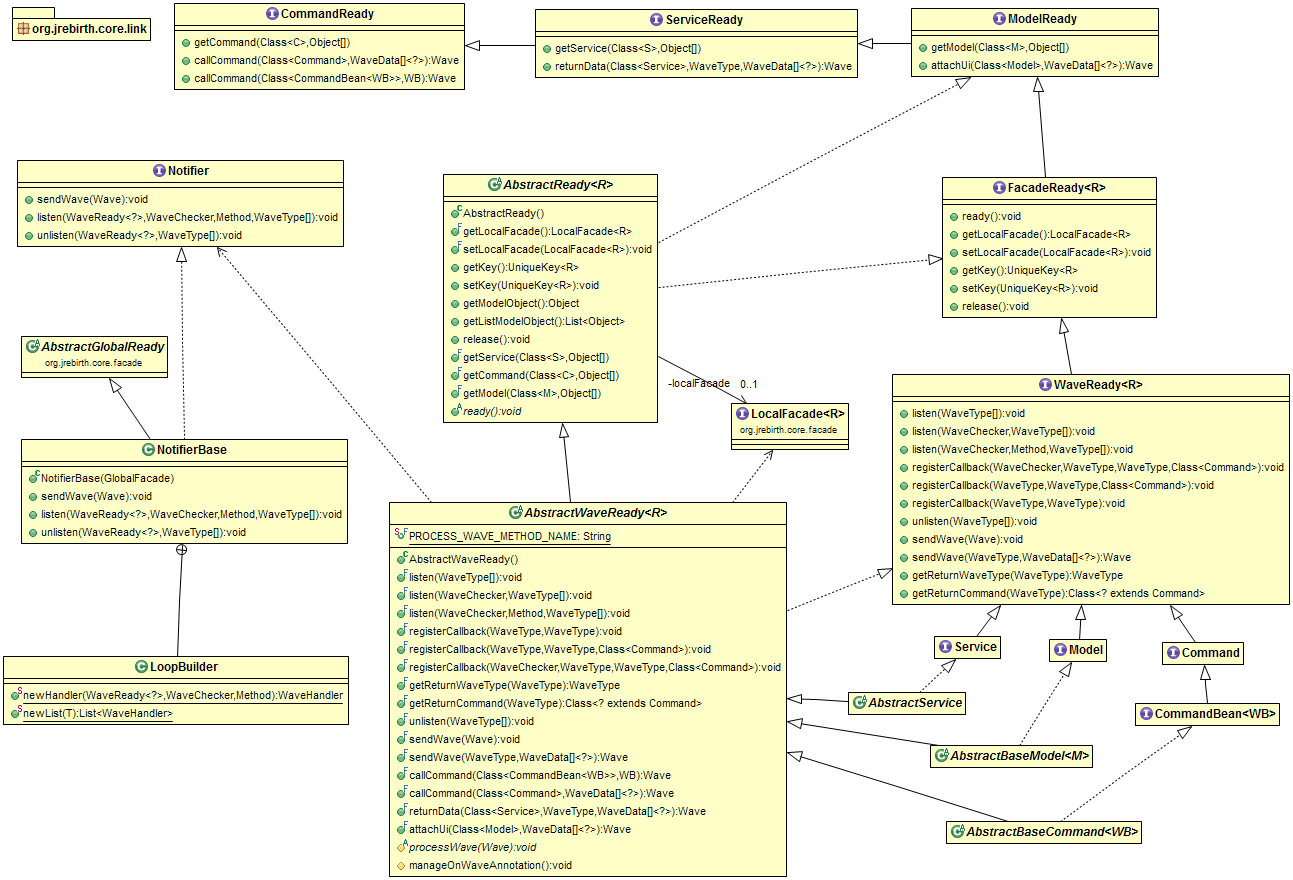
Notifier Overview
JRebirth has got its own Notification Engine to allow each component to communicate with each other. All these communications are processed into a dedicated thread described before. The notification engine uses custom objects to transport data: Waves.
The Notifier is JRebirth's internal event bus, running on JIT (JRebirth Internal Thread). It dispatches Wave objects to any component that has registered interest in a particular WaveType. This decoupled messaging system ensures that Models, Services, and Commands can interact without holding direct references to one another.
The typical flow is:
- A component registers (listens) for one or more WaveTypes.
- Another component sends a Wave carrying a WaveType and optional data.
- The Notifier finds every component that listens for that WaveType and invokes the matching handler method.
Registering for Waves
To receive Waves, a component must call listen(WaveType...) during its initialization phase.
For a Model this is typically done inside initModel(), for a Service inside initService(), and for a Command inside initCommand().
The listen method is defined in the Component interface:
package org.jrebirth.af.api.component.basic;

import java.lang.reflect.Method;

import org.jrebirth.af.api.facade.FacadeReady;
import org.jrebirth.af.api.wave.Wave;
import org.jrebirth.af.api.wave.WaveBean;
import org.jrebirth.af.api.wave.checker.WaveChecker;
import org.jrebirth.af.api.wave.contract.WaveData;
import org.jrebirth.af.api.wave.contract.WaveType;

/**
 * The interface <strong>EnhancedComponent</strong>.
 *
 * Define the contract used to manage waves.
 *
 * @author Sébastien Bordes
 *
 * @param <R> A type that implements FacadeReady
 */
public interface Component<R extends FacadeReady<R>> extends FacadeReady<R> {

    /**
     * Begin to listen the type of wave for the current component.
     *
     * Wave Contract will be checked if {@link org.jrebirth.af.core.resource.provided.JRebirthParameters.DEVELOPER_MODE} parameter is true
     *
     * @param waveType the type(s) to listen
     */
    void listen(final WaveType... waveType);

    /**
     * Begin to listen the type of wave for the current component.
     *
     * Wave Contract will be checked if {@link org.jrebirth.af.core.resource.provided.JRebirthParameters.DEVELOPER_MODE} parameter is true
     *
     * The wave checker is used to filter the wave if the checker returns false
     *
     * @param waveChecker the wave checker used to forward the wave only if the checker return true
     * @param waveType the type(s) to listen
     */
    void listen(final WaveChecker waveChecker, final WaveType... waveType);

    /**
     * Begin to listen the type of wave for the current component.
     *
     * Wave Contract will be checked if {@link org.jrebirth.af.core.resource.provided.JRebirthParameters.DEVELOPER_MODE} parameter is true
     *
     * The wave checker is used to filter the wave if the checker returns false
     *
     * @param waveChecker the wave checker used to forward the wave only if the checker return true
     * @param method the annotated method concerned
     * @param waveType the type(s) to listen
     */
    void listen(final WaveChecker waveChecker, final Method method, final WaveType... waveType);

    /**
     * Stop to listen the type of wave for the current component.
     *
     * @param waveTypes the type(s) to stop to listen
     */
    void unlisten(final WaveType... waveTypes);

    /**
     * Send a wave to the notifier.
     *
     * The wave will automatically be sent from JRebirthThread.
     *
     * @param wave the wave to send
     */
    void sendWave(final Wave wave);

    /**
     * Send a wave to the notifier.
     *
     * The wave will automatically be sent from JRebirthThread.
     *
     * @param waveType the type of wave to send
     * @param waveBean the wave bean
     *
    // ...
You can listen for several WaveTypes at once:
@Override
protected void initModel() {
    listen(MyWaves.DO_ACTION_A, MyWaves.DO_ACTION_B);
}
initModel()— correct hook for Models; Services useinitService(), Commands useinitCommand().listen(...)— registers this component with the Notifier (strong reference untilunlisten).- Multiple
WaveTypes — one registration call for all events this component handles.
When listen is called, the component registers itself with the Notifier for the given WaveType(s).
The Notifier holds a strong reference to the component, so it will not be garbage-collected as long as it remains registered.
Here is a real-world example from the Analyzer showcase:
package org.jrebirth.af.showcase.analyzer.ui.controls;

import java.util.List;

import org.jrebirth.af.api.facade.JRebirthEvent;
import org.jrebirth.af.api.wave.Wave;
import org.jrebirth.af.core.ui.DefaultModel;
import org.jrebirth.af.showcase.analyzer.service.LoadEdtFileService;
import org.jrebirth.af.showcase.analyzer.ui.editor.EditorWaves;

/**
 * The class <strong>ControlsModel</strong>.
 *
 * @author Sébastien Bordes
 */
public final class ControlsModel extends DefaultModel<ControlsModel, ControlsView> {

    /**
     * {@inheritDoc}
     */
    @Override
    protected void initModel() {
        listen(LoadEdtFileService.DO_LOAD_EVENTS.returnWaveType());
        listen(EditorWaves.DO_UNLOAD);
    }

    /**
     * Call when event are loaded.
     *
     * @param eventList the list of events loaded
     *
     * @param wave the wave received
     */
    public void doEventsLoaded(final List<JRebirthEvent> eventList, final Wave wave) {
        view().activateButtons(!eventList.isEmpty());
    }

    /**
     * Call when event are loaded.
     *
     * @param wave the wave received
     */
    public void doUnload(final Wave wave) {
        view().activateButtons(false);
    }
}
listen(...returnWaveType())— service return waves use.returnWaveType()on the entryWaveType.doEventsLoaded(List, Wave)— name from return actionEVENTS_LOADED; updates View viaview().doUnload(Wave)— parameterless action wave; only the trailingWaveargument is required.
The handler method name is derived from the WaveType action. For example, if the WaveType action is DO_LOAD_EVENTS, the handler method must be named doEventsLoaded (camelCase, matching the action string).
    public void doEventsLoaded(final List<JRebirthEvent> eventList, final Wave wave) {
        view().activateButtons(!eventList.isEmpty());
    }
Unregistering
To stop receiving Waves, call unlisten(WaveType...).
This removes the component from the Notifier and releases the strong reference, preventing potential memory leaks.
    void unlisten(final WaveType... waveTypes);

    /**
     * Send a wave to the notifier.
     *
     * The wave will automatically be sent from JRebirthThread.
     *
     * @param wave the wave to send
     */
    void sendWave(final Wave wave);

    /**
     * Send a wave to the notifier.
     *
     * The wave will automatically be sent from JRebirthThread.
     *
     * @param waveType the type of wave to send
     * @param waveBean the wave bean
     *
     * @return the wave created and sent to JIT, be careful when you use a strong reference it can hold a lot of objects
     */
    <WB extends WaveBean> Wave sendWave(final WaveType waveType, final WB waveBean);

    /**
     * Send a wave to the notifier.
     *
     * The wave will automatically be sent from JRebirthThread.
     *
     * @param waveType the type of wave to send
     * @param waveData the data (key-value
     *
     * @return the wave created and sent to JIT, be careful when you use a strong reference it can hold a lot of objects
     */
    Wave sendWave(final WaveType waveType, final WaveData<?>... waveData);

    /**
     * Return the root component (for inner component).
     *
     * @return the root component of the inner component
     */
    Component<?> rootComponent();

    /**
     * Define the root component for an inner component.
     *
     * @param rootComponent The root component to set.
     */
    void rootComponent(final Component<?> rootComponent);

    // /**
    // * Add an inner component.
    // *
    // * It will instantiate the component from the right Facade and store it into the current component.
    // *
    // * Shall be called from {@link AbstractComponent}.initInnerComponent (protected API)
@Override
protected void unlistenOnDispose() {
    unlisten(MyWaves.DO_REFRESH);
}
unlisten(WaveType...)— removes this component from the Notifier for those types.- Models are auto-unlistened on release; call explicitly for long-lived components that change behavior.
Sending Waves
Any component can send a Wave via the sendWave methods defined on the Component interface:
package org.jrebirth.af.api.component.basic;

import java.lang.reflect.Method;

import org.jrebirth.af.api.facade.FacadeReady;
import org.jrebirth.af.api.wave.Wave;
import org.jrebirth.af.api.wave.WaveBean;
import org.jrebirth.af.api.wave.checker.WaveChecker;
import org.jrebirth.af.api.wave.contract.WaveData;
import org.jrebirth.af.api.wave.contract.WaveType;

/**
 * The interface <strong>EnhancedComponent</strong>.
 *
 * Define the contract used to manage waves.
 *
 * @author Sébastien Bordes
 *
 * @param <R> A type that implements FacadeReady
 */
public interface Component<R extends FacadeReady<R>> extends FacadeReady<R> {

    /**
     * Begin to listen the type of wave for the current component.
     *
     * Wave Contract will be checked if {@link org.jrebirth.af.core.resource.provided.JRebirthParameters.DEVELOPER_MODE} parameter is true
     *
     * @param waveType the type(s) to listen
     */
    void listen(final WaveType... waveType);

    /**
     * Begin to listen the type of wave for the current component.
     *
     * Wave Contract will be checked if {@link org.jrebirth.af.core.resource.provided.JRebirthParameters.DEVELOPER_MODE} parameter is true
     *
     * The wave checker is used to filter the wave if the checker returns false
     *
     * @param waveChecker the wave checker used to forward the wave only if the checker return true
     * @param waveType the type(s) to listen
     */
    void listen(final WaveChecker waveChecker, final WaveType... waveType);

    /**
     * Begin to listen the type of wave for the current component.
     *
     * Wave Contract will be checked if {@link org.jrebirth.af.core.resource.provided.JRebirthParameters.DEVELOPER_MODE} parameter is true
     *
     * The wave checker is used to filter the wave if the checker returns false
     *
     * @param waveChecker the wave checker used to forward the wave only if the checker return true
     * @param method the annotated method concerned
     * @param waveType the type(s) to listen
     */
    void listen(final WaveChecker waveChecker, final Method method, final WaveType... waveType);

    /**
     * Stop to listen the type of wave for the current component.
     *
     * @param waveTypes the type(s) to stop to listen
     */
    void unlisten(final WaveType... waveTypes);

    /**
     * Send a wave to the notifier.
     *
     * The wave will automatically be sent from JRebirthThread.
     *
     * @param wave the wave to send
     */
    void sendWave(final Wave wave);

    /**
     * Send a wave to the notifier.
     *
     * The wave will automatically be sent from JRebirthThread.
     *
     * @param waveType the type of wave to send
     * @param waveBean the wave bean
     *
    // ...
There are several ways to send a Wave:
1. Using WaveType + WaveData
sendWave(MyWaves.DO_REFRESH, WBuilder.waveData(MyWaves.ITEM, selectedItem));
sendWave(waveType, waveData...)— builds the wave and posts it to JIT for dispatch.WBuilder.waveData(item, value)— pairs aWaveItemkey with the payload value.
2. Using WaveType + WaveBean
sendWave(MyWaves.DO_REFRESH, myWaveBean);
sendWave(waveType, waveBean)— typed bean instead of varargsWaveData; good for many fields.
3. Using a pre-built Wave with WBuilder
The WBuilder fluent API offers a convenient way to create and configure Waves before sending them:
sendWave(WBuilder.callCommand(MyCommand.class));
WBuilder.callCommand(Class)— builds a Call Command wave ready to send.- Equivalent to
callCommand(MyCommand.class)but useful when chaining waves.
How to use — end-to-end
- Define
WaveType+WaveItemconstants in a shared interface. - In the receiver:
listen(waveType)insideinitModel/initService/initCommand. - Add handler method (
doActionName(...)) matching items + trailingWave. - In the sender:
sendWave(waveType, WBuilder.waveData(item, value)). - Call
unlistenwhen the receiver should stop reacting.
Wave Dispatching
When a Wave is sent, the following sequence occurs:
- The Wave is queued on JIT (JRebirth Internal Thread).
- The Notifier looks up all components registered for the Wave's
WaveType. - For each registered component, the Notifier resolves the handler method by convention:
- The WaveType has an action name (e.g.
"DO_MY_ACTION"). - The action name is converted to camelCase:
doMyAction. - The Notifier calls this method via reflection, passing the Wave and any typed data items.
- The WaveType has an action name (e.g.
- If a
WaveCheckeris registered for that component + WaveType pair, it is evaluated first — the handler is invoked only when the checker returnstrue.
This convention-over-configuration approach keeps handler wiring completely declarative.
@OnWave Annotation
As an alternative to calling listen() manually, you can annotate a method with @OnWave.
The framework will auto-register the component for the specified WaveType at startup.
The annotation accepts a single value attribute matching the WaveType action string:
@OnWave("MY_ACTION")
protected void myMethod(Wave wave) {
    // handle wave
}
@OnWave("MY_ACTION")— auto-registers at startup; method name is free.- Value must match the
WaveTypeaction string exactly.
The method name is free — only the annotation value must match the WaveType action.
@OnWave is repeatable, so a single method can listen for multiple WaveTypes.
Here is a real example from the Wave showcase:
@Register(value = ModuleModel.class)
public class MainModel extends DefaultFXMLModel<MainModel> implements ModuleModel {

    @OnWave(WWaves.CHANGE)
    protected void whatyouwant(Wave wave) {
        getFXMLController().txtMessage.setText("Wave received : " + wave.waveType().action());
    }

    @Override
    public String moduleName() {
        return "Wave";
    }

    @Override
    public MainController getFXMLController() {
        return (MainController) super.getFXMLController();
    }

}
@OnWave(WWaves.CHANGE)— listens without callinglisten()ininitModel().- Method name (
whatyouwant) is arbitrary; only the annotation value matters. wave.waveType().action()— inspect which action was received at runtime.
JRebirth itself uses @OnWave internally for built-in UI actions (see Built-in WaveTypes below):
@OnWave(WaveConstants.SHOW_VIEW)
void doShowView(final Wave wave);

@OnWave(WaveConstants.HIDE_VIEW)
void doHideView(final Wave wave);
- Built into the
Modelinterface — every Model handles show/hide automatically. - Trigger visibility from any component with
WBuilder.showModel(...)/ hide waves.
WaveChecker
A WaveChecker lets you filter incoming Waves for a specific component.
Only Waves for which the checker returns true are dispatched to the handler method.
WaveChecker is a @FunctionalInterface extending Callback<Wave, Boolean>:
@FunctionalInterface
public interface WaveChecker extends Callback<Wave, Boolean> {

}
WaveChecker— functional interface:boolean call(Wave wave).- Return
trueto dispatch to the handler;falseskips this listener for that wave.
You register a checker with the overloaded listen method:
package org.jrebirth.af.api.component.basic;

import java.lang.reflect.Method;

import org.jrebirth.af.api.facade.FacadeReady;
import org.jrebirth.af.api.wave.Wave;
import org.jrebirth.af.api.wave.WaveBean;
import org.jrebirth.af.api.wave.checker.WaveChecker;
import org.jrebirth.af.api.wave.contract.WaveData;
import org.jrebirth.af.api.wave.contract.WaveType;

/**
 * The interface <strong>EnhancedComponent</strong>.
 *
 * Define the contract used to manage waves.
 *
 * @author Sébastien Bordes
 *
 * @param <R> A type that implements FacadeReady
 */
public interface Component<R extends FacadeReady<R>> extends FacadeReady<R> {

    /**
     * Begin to listen the type of wave for the current component.
     *
     * Wave Contract will be checked if {@link org.jrebirth.af.core.resource.provided.JRebirthParameters.DEVELOPER_MODE} parameter is true
     *
     * @param waveType the type(s) to listen
     */
    void listen(final WaveType... waveType);

    /**
     * Begin to listen the type of wave for the current component.
     *
     * Wave Contract will be checked if {@link org.jrebirth.af.core.resource.provided.JRebirthParameters.DEVELOPER_MODE} parameter is true
     *
     * The wave checker is used to filter the wave if the checker returns false
     *
     * @param waveChecker the wave checker used to forward the wave only if the checker return true
     * @param waveType the type(s) to listen
     */
    void listen(final WaveChecker waveChecker, final WaveType... waveType);

    /**
     * Begin to listen the type of wave for the current component.
     *
     * Wave Contract will be checked if {@link org.jrebirth.af.core.resource.provided.JRebirthParameters.DEVELOPER_MODE} parameter is true
     *
     * The wave checker is used to filter the wave if the checker returns false
     *
     * @param waveChecker the wave checker used to forward the wave only if the checker return true
     * @param method the annotated method concerned
     * @param waveType the type(s) to listen
     */
    void listen(final WaveChecker waveChecker, final Method method, final WaveType... waveType);

    /**
     * Stop to listen the type of wave for the current component.
     *
     * @param waveTypes the type(s) to stop to listen
     */
    void unlisten(final WaveType... waveTypes);

    /**
     * Send a wave to the notifier.
     *
     * The wave will automatically be sent from JRebirthThread.
     *
     * @param wave the wave to send
     */
    void sendWave(final Wave wave);

    /**
     * Send a wave to the notifier.
     *
     * The wave will automatically be sent from JRebirthThread.
     *
     * @param waveType the type of wave to send
     * @param waveBean the wave bean
     *
    // ...
Example — listen only if the Wave carries a non-null data item:
listen(wave -> wave.contains(MyWaves.ITEM), MyWaves.DO_REFRESH);
Threading
By default, wave handler methods run on the thread natural to the component type:
| Component Type | Default Thread |
|---|---|
| Model | JAT (JavaFX Application Thread) |
| Service | JTP (JRebirth Thread Pool) |
| Command | Depends on command type (JIT, JAT, or JTP) |
You can override the default thread for any handler method with the @RunInto annotation:
@RunInto(RunType.JTP)
public void doHeavyComputation(final Wave wave) {
    // runs in the thread pool instead of JAT
}
@RunInto(JTP)— override default handler thread for this method only.- Models default to JAT; Services default to JIT — use when work must move off that thread.
Available RunType values: JAT, JAT_SYNC, JIT, JIT_SYNC, JTP, JTP_SYNC, SAME.
You can also set a runnable priority:
@RunInto(value = RunType.JTP, priority = PriorityLevel.Highest)
public void doCriticalTask(final Wave wave) { ... }
priority = PriorityLevel.Highest— prefer HPTP slot when JTP is busy.- Combine with
@RunInto(JTP)for time-sensitive background handlers.
Built-in WaveTypes
JRebirth ships with several built-in WaveTypes defined in WaveConstants and used across the framework:
| Constant | Purpose |
|---|---|
WaveConstants.SHOW_VIEW |
Show a Model's root node in the scene graph |
WaveConstants.HIDE_VIEW |
Hide a Model's root node from the scene graph |
WaveConstants.RETURN_VOID |
Used internally for void-returning service tasks |
Models automatically listen for SHOW_VIEW and HIDE_VIEW through the @OnWave annotations declared on the Model interface, so you can trigger view visibility from any component:
sendWave(WBuilder.showModel(TargetModel.class, myPlaceholder));
WBuilder.showModel(Class, Node)— shows the Model's root node insidemyPlaceholder.- Uses built-in
SHOW_VIEWwave; always processed on JAT.